The final day of the Jean Monnet summer school European Values and Migration (EUAMI), held on Friday 17 July, brought together the knowledge and skills students had developed throughout the week.
Following visits to the European institutions, discussions on migration policies and meetings with civil society organisations, participants explored the role of regional representations in Brussels before completing the final stage of the simulation of the Foreign Affairs Council of the European Union, the flagship activity of the summer school.
Bringing regional voices to Brussels
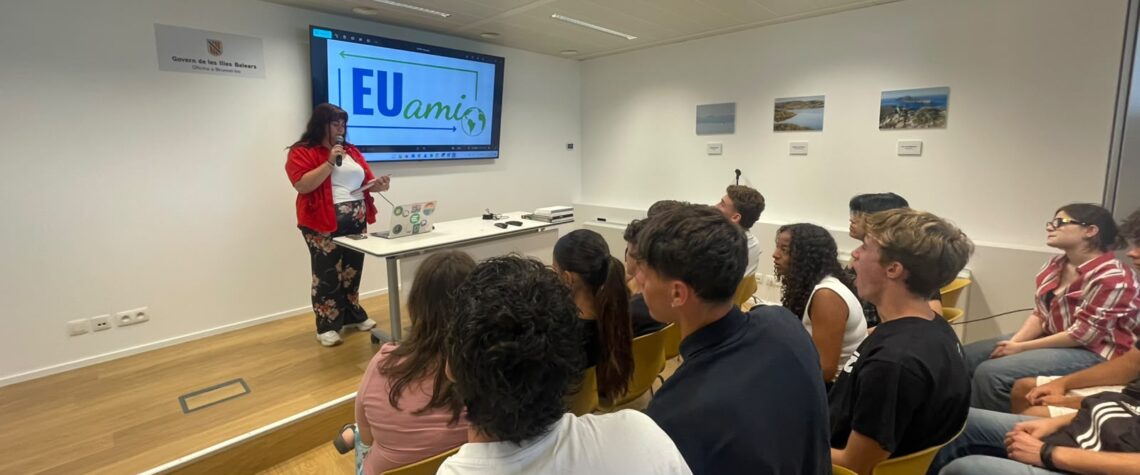
The day began at the Brussels Office of the Government of the Balearic Islands, where students discovered how regional authorities engage with the European Union and ensure that local interests are represented in the European policymaking process.
During the presentation, members of the office explained how regional representations act as a bridge between their territories and the EU institutions. Their work includes monitoring legislative developments, maintaining dialogue with the European Commission, the European Parliament and the Council of the European Union, promoting regional priorities and creating opportunities for cooperation with other European regions.
Students were also introduced to the different responsibilities within the office, gaining insight into the diverse areas in which regional representatives operate, from policy monitoring and institutional relations to environmental and territorial cooperation.
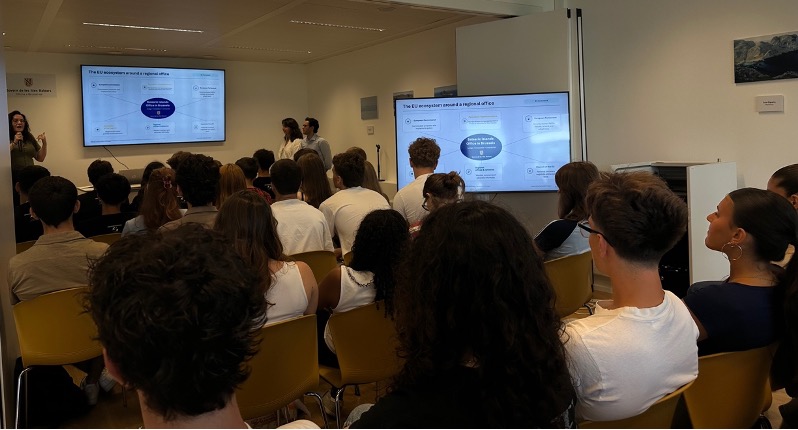
Following the presentation, students were divided into national delegations representing Bulgaria, Italy, Poland and Spain to reflect on challenges affecting their own countries and regions. Each group identified an issue they considered particularly relevant and discussed how regional institutions could help address it while working alongside European policymakers. Topics ranged from public safety and justice to housing affordability and broader social concerns, demonstrating how local issues often have a European dimension and can benefit from cooperation across different levels of governance.
The exercise encouraged participants to move beyond theory by applying the institutional knowledge acquired during the week to concrete policy challenges, highlighting the important role regional authorities play in connecting citizens with the European Union.
Negotiating the final agreement
Students reconvened for the concluding session of the simulation of the Foreign Affairs Council of the European Union, bringing to an end an exercise that had accompanied them throughout the entire summer school.
From school desks to the heart of Europe: our experience at the EUAMI summer school 2026
Working in their assigned roles as representatives of Member States, EP rapporteur, NGOs and human rights organisations, participants entered the final phase of negotiations on the proposed Return Regulation. Building on the positions they had developed earlier in the week, delegations debated amendments, defended their priorities and worked to reach compromises before proceeding to the final vote.
Students agreed on a series of amendments concerning Articles 9 and 17 of the proposal before adopting their final positions. The simulation offered participants a practical understanding of the complexity of European decision-making, demonstrating how legislation is shaped through negotiation, cooperation and the reconciliation of different national and political interests.
Having worked on the simulation over several days, students experienced first-hand the importance of dialogue, compromise and consensus-building in the European legislative process.
The summer school concluded with an interactive quiz designed to revisit the topics explored throughout the week. Questions tested students’ knowledge of the European Union, its institutions, its history and its decision-making processes, covering themes such as the Maastricht Treaty, the number of official EU languages and the roles of the different European institutions.
“Ask what it would take”: inside the European Parliament, EUAMI students meet the MEP Giorgio Gori
Bringing together institutional visits, policy discussions, simulations and interactive workshops, the EUAMI Summer School offered participants a unique opportunity to experience the European Union from multiple perspectives. From understanding how decisions are made in Brussels to reflecting on the human dimension of migration and the importance of regional representation, students concluded the week with a broader appreciation of the values, institutions and democratic processes that shape the European project.
The EUAMI project, whose summer school took place in Brussels from 13 to 17 July, is led by the University of Padua together with a consortium of five secondary schools: the Emilian Stanev School Union from Bulgaria, the Enrico Fermi Institute of Mantua and the Canossa Campus of Brescia from Italy, the Zespół Szkół Administracyjno-Ekonomicznych from Poland, and the Sant Josep Obrer school from Spain. CesUE and Focus Europe Italia support the initiative as media partners.